
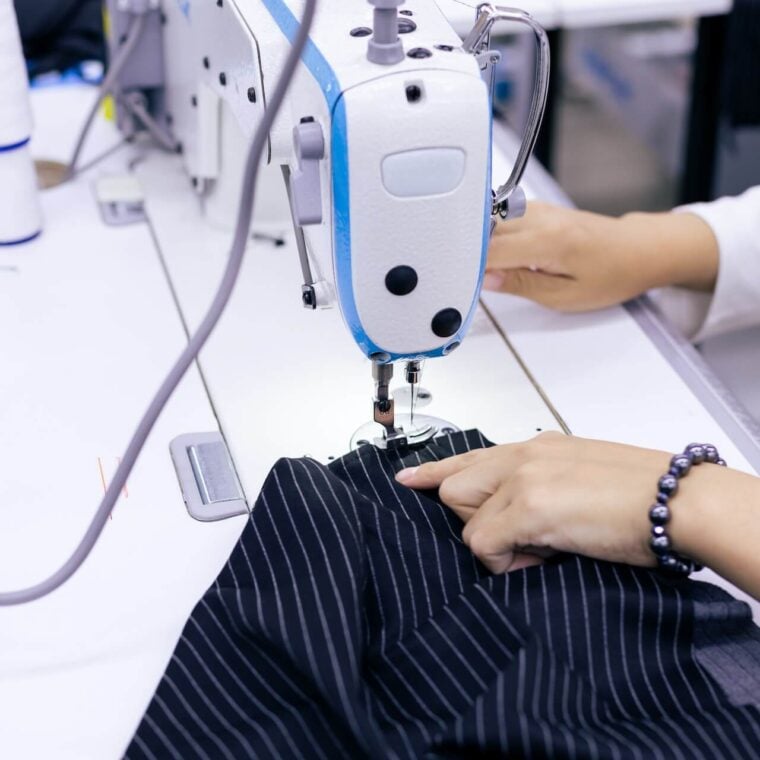

AQL is the number that decides whether your order ships or gets rejected, yet most explanations of it stop at the textbook definition. After 20+ years running quality control on export orders in Tirupur, here is what AQL actually means, how the sample sizes and defect limits really work, and a real inspection from our floor that failed, shown in full. This is quality control as it happens, not as a spec sheet describes it.
What Is AQL in the Garment Industry?
AQL stands for Acceptable Quality Limit. It is a statistical sampling method that lets a buyer or manufacturer judge the quality of an entire production lot by inspecting a small random sample rather than every single piece. Instead of checking all 1,350 garments in an order, an inspector checks a defined sample, counts the defects, and compares that count against the number allowed for the chosen AQL level. If the defects stay within the limit, the lot passes. If they exceed it, the lot is rejected. The full form of AQL in the garment industry is simply Acceptable Quality Limit, and it is the backbone of pre-shipment inspection worldwide.
AQL 1.5 vs AQL 2.5 vs 4.0: What Each Level Means
The AQL number is the percentage of defects a buyer is willing to tolerate. A lower number is stricter. Defects are also graded as critical, major, or minor, and each grade has its own tolerance.
| AQL Level | Strictness | Typically Used For |
|---|---|---|
| AQL 1.5 | Strict | Babywear, kidswear, and products where safety and finish are critical |
| AQL 2.5 | Standard | Most apparel. The common default for t-shirts, hoodies, and general garments |
| AQL 4.0 | Relaxed | Lower-cost or promotional goods where minor defects matter less |
Our default across all goods is AQL 2.5, moving to the stricter 1.5 where a buyer or product requires it.
How AQL Sample Size Works
You do not inspect the whole order. Based on the total order quantity, a standard sampling table gives you a sample size to pull at random, along with the number of major and minor defects allowed for your AQL level. Inspect the sample, count the defects by grade, and compare against the allowance. The larger the order, the larger the sample, but you are still checking a fraction of the total. This is what makes AQL efficient: it gives a statistically sound verdict on thousands of pieces from a sample of a hundred or so.
A Real AQL Inspection From Our Floor (That Failed)
Most manufacturers only show you inspections that passed. Here is one that did not, because a failed report teaches more about AQL than a clean one. This was a final inspection on a babywear order of 1,350 pieces in single jersey, inspected at AQL 2.5.
| Inspection Metric | Result |
|---|---|
| Total order quantity | 1,350 pieces |
| AQL 2.5 sample size pulled | 125 pieces |
| Minor defects allowed | 10 |
| Minor defects found | 15 |
| Major defects allowed | 7 |
| Major defects found | 21 |
| Verdict | Not Approved |
📄 View the Full Real Inspection Report (PDF)
The sample of 125 pieces returned 15 minor defects against 10 allowed, and 21 major defects against 7 allowed. Both exceeded the AQL 2.5 limit, so the lot was rejected. The actual defects were the everyday failures that real production throws up: needle marks on the fabric, skip stitches, uncut threads, a stain, and improperly attached elastic on the waistband. None of these are exotic. They are exactly the defects a proper inspection is designed to catch before the goods reach a buyer, which is the entire point of running AQL rather than trusting a clean sample.
What Happens When a Lot Fails AQL
A failed inspection is not the end of the order, it is a decision point. When a lot fails, the result goes to our production director, who decides the next step based on the nature of the defects. The options are a re-inspection after sorting, redoing or repairing the affected goods, or, where the defects are genuinely borderline, a commercial acceptance in agreement with the buyer.
There is an important nuance here that experience teaches you. A strict system will sometimes grade a defect as major when, in practice, it is commercially minor. The statistics do not always match the real-world severity of what is on the garment. This is why the final judgment sits with an experienced person, not the software alone. The number tells you to stop and look; a human decides what the defect actually means for the buyer.
How Our ERP Calculates AQL and Alerts the Team Automatically
This is where our quality control goes beyond a clipboard and a sampling chart. Our inspection is built into our own ERP system. As the inspector records defects during the check, the system calculates the AQL result in real time against the required standard. If the calculated result falls below the standard, the ERP automatically sends an email alert to the production team so that action is taken immediately rather than discovered later.
That alert goes to our production director, who then decides whether to order a re-inspection, redo the goods, or, for genuinely borderline cases, discuss a commercial acceptance with the buyer. The value of this is speed and accountability. A failing lot cannot quietly slip through, because the moment the numbers cross the line, the whole chain of responsibility is notified. For a brand, it means quality issues are caught and owned inside the factory, before the goods are ever offered for shipment.
Why this matters for your brand
AQL is only as good as the honesty behind it. A manufacturer who runs real inspections, records real defects, and shows you a failed report is a manufacturer you can trust with your production. If you want to see how we manage quality across your order, explore our clothing manufacturing services, and our guide on how to cost a garment shows where quality control fits into the true cost of production.
Frequently Asked Questions
What is AQL in the garment industry?
AQL, or Acceptable Quality Limit, is the maximum number of defective pieces allowed in a random inspection sample before a production lot is rejected. It lets a buyer judge the quality of an entire order by inspecting a small sample rather than every piece.
What is the difference between AQL 1.5 and AQL 2.5?
AQL 1.5 is stricter and allows fewer defects, and is typically used for babywear, kidswear, and products where finish and safety are critical. AQL 2.5 is the standard level for most apparel. A lower AQL number means a tighter tolerance for defects.
What AQL level is used for babywear?
Babywear is usually inspected at the stricter AQL 1.5 because safety and finish matter more, though many orders are still run at AQL 2.5 depending on the buyer. Our default is AQL 2.5 across all goods, moving to 1.5 where the product or buyer requires it.
What happens when a garment shipment fails AQL inspection?
A failed lot goes to the production director, who decides whether to sort and re-inspect, redo or repair the affected goods, or, for genuinely borderline defects, agree a commercial acceptance with the buyer. A failure is a decision point, not an automatic write-off.
What is the AQL 2.5 sample size for a large order?
The sample size depends on the total order quantity, set by a standard sampling table. In a real inspection of 1,350 pieces at AQL 2.5, the sample size was 125 pieces, with 10 minor and 7 major defects allowed before rejection.
Can a defect be graded major when it is really minor?
Yes. A strict system can grade a defect as major when it is commercially minor in practice, because the statistics do not always match real-world severity. This is why the final judgment should rest with an experienced person rather than the software alone.

About the Author: Karthik Shan
Karthik Shan is the founder and CEO of The Synerg, with 20+ years in the Tirupur textile hub. He publishes practical playbooks for brands on fabric GSM, costing (CM/CMT), AQL quality standards, and export-ready production.