
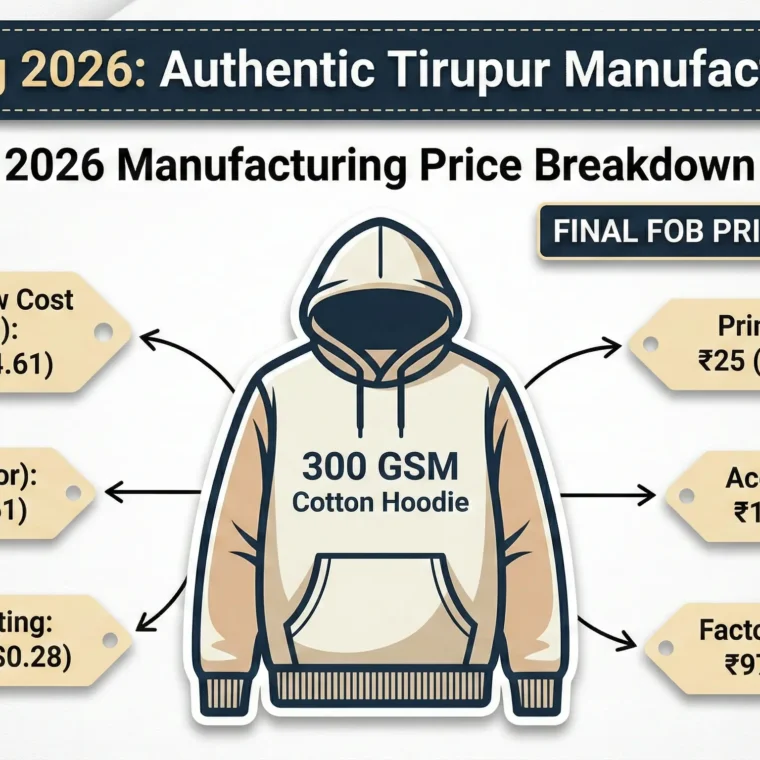

Heavyweight hoodie manufacturing cost is decided far more by fabric than by labour, and most price surprises come from not knowing that. Many brands ask factories for a price list, but a hoodie price is a calculation, not a menu. This case study shares The Synerg’s own costing data for September 2026, taken from a real order produced in our Tirupur factory, and compares a standard 300 GSM hoodie with a 500 GSM heavyweight version so you can see exactly where the money goes.
The Baseline: A $6.60 Standard Hoodie From a Real Invoice
The figures below come from a redacted invoice for a September 2026 hoodie order we produced for a Spanish brand. The garment is a 100% cotton loop knit (French terry) hoodie at 280 to 300 GSM, with a standard chest print, woven labels, and drawstrings. Every line is what the order actually cost, not an estimate.
| Cost Component | Spec / Metric | Cost (USD) |
|---|---|---|
| Fabric | ₹550/kg, 730 g consumption per piece | $4.61 |
| CMT (labour) | Cut, make, trim | $0.61 |
| Printing | Standard chest print | $0.28 |
| Accessories | Labels, drawstrings | $0.17 |
| Factory margin | Overheads and profit | $0.93 |
| Final FOB price | Packed and ready to ship | $6.60 |
Why Fabric Decides the Cost to Make a Hoodie
Look at the table again: fabric is $4.61 of the $6.60, about 70% of the total, while sewing is only $0.61. That is why pressing a factory for a lower CMT rate barely moves the final number. The real levers on the cost to make a hoodie are the fabric weight, the fibre, and how much fabric each piece consumes, which depends on the fit and the marker. A boxy or oversized pattern wastes more fabric than a regular fit, even at the same GSM. Our guide to calculating fabric consumption for knit garments shows how that number is worked out, and our comparison of the most common hoodie GSMs explains how weight changes the feel and drape of the garment.
Heavyweight Hoodie Manufacturing Cost: 300 GSM vs 500 GSM
Brands often expect a 500 GSM hoodie to cost only a little more than a standard one. In practice the price nearly doubles, for two reasons. First, the fabric consumption rises from 730 grams to about 1.2 kg per piece, partly because heavyweight styles are usually cut boxy, which adds cutting waste. Second, thick fabric is slower to handle at every stage: the knitting machines run slower, and sewing heavy seams takes longer, so CMT almost doubles as well.
| Component | Standard (300 GSM) | Heavyweight (500 GSM) |
|---|---|---|
| Fabric consumption | 730 g | About 1.2 kg (boxy fit waste) |
| Fabric cost | $4.61 | $8.50 |
| CMT (labour) | $0.61 | $1.10 (slower stitching) |
| Estimated FOB | $6.60 | About $12.50 |
If 500 GSM pushes your retail price too high, a 350 GSM fabric is a sensible middle ground. It typically adds only about $0.40 to the base fabric cost of the standard hoodie while still giving a noticeably fuller hand feel. Any heavyweight hoodie manufacturer should be able to show you both weights side by side before you commit, and we recommend comparing them as physical samples rather than on paper.
Freight: Sea vs Air Cost per Hoodie
Once the goods are packed, the shipping mode can change the per-piece cost more than any negotiation on the garment itself. These are our September 2026 benchmarks for an order of 500 standard hoodies shipped to the UK or USA.
| Mode | Transit Time | Cost per Hoodie (500 units) | Best Used For |
|---|---|---|---|
| Sea freight (LCL) | About 40 to 45 days | About $0.85 | Planned bulk and wholesale orders |
| Air freight | About 5 to 7 days | About $5.20 | Urgent top-ups and launch stock only |
Air freight costs almost as much as the garment itself, so it rarely makes sense for wholesale margins. Planning the order around realistic production and sea transit times is the simplest way to protect the price.
From Hoodie FOB Price to Landed Cost
The hoodie FOB price is only the price at the Indian port. What you actually pay per piece in your warehouse is the landed cost, which adds freight, duty, import taxes, and clearance. For a UK buyer, the picture changed in 2026: the India-UK trade agreement came into force on 15 July 2026 and gives Indian garments zero-duty entry, provided the shipment carries valid proof of Indian origin. Import VAT at 20% still applies, but VAT-registered businesses can normally reclaim it. Using the standard hoodie above, 500 pieces by sea to the UK work out as follows.
| Line | Per Hoodie (USD) | Note |
|---|---|---|
| FOB price | $6.60 | 300 GSM French terry, chest print |
| Sea freight | $0.85 | LCL, 500 units |
| UK import duty | $0.00 | Under the India-UK agreement, with origin proof |
| Lab testing | About $0.05 | About $27 per batch, spread over 500 pieces |
| Cost before VAT | About $7.50 | Excludes local clearance and delivery charges |
| Import VAT (20%) | About $1.49 | Charged on goods plus freight; reclaimable if VAT-registered |
Duty rates for the USA, the EU, and other markets are different and can change, so check the current rate for your product code before you set a retail price. If you would rather not handle freight, duty, and clearance yourself, ask for a DDP (delivered duty paid) quote, where one price covers delivery to your door. Our breakdown of what it costs to produce a t-shirt in India uses the same method for lighter garments.
Hidden Costs That Do Not Appear on the Garment Price
Three costs catch brands out most often. The first is lab testing: shrinkage, GSM, and colour fastness checks cost about $27 per batch, and buyers with strict quality programmes may ask for more tests. The second is bank charges on international wire transfers or letters of credit, which apply to every payment. The third is sampling, which is paid before bulk production starts; our guide to how much clothing samples cost explains how sample prices are set and when they are refunded. None of these is large on its own, but together they add to the true hoodie manufacturing cost and decide whether you earn the margin you planned. For the wider costing methods factories use, see the eight types of costing in the garment industry.
Our recommendation
Decide the fabric weight first, because it sets most of the hoodie manufacturing cost, and sample 350 GSM before committing to 500 GSM. Ship by sea unless the launch date truly cannot move, and compare quotes on a landed basis rather than FOB alone. We produce hoodies from 300 pieces per colour per style, with knit orders taking 75 to 90 days from purchase order to shipment. Brands selling in Europe can see our hoodie manufacturing for European brands.
Frequently Asked Questions
Is $6.50 a fair FOB price for a 100% cotton French terry hoodie?
Yes. Our September 2026 production data from Tirupur puts a standard 300 GSM loop knit (French terry) hoodie with a chest print at about $6.60 FOB, including fabric, CMT, printing, accessories, and the factory margin. A quote far below that usually means lighter fabric or a lower cotton quality.
How much does it cost to manufacture a 500 GSM heavyweight hoodie?
A 500 GSM heavyweight hoodie costs about $12.50 FOB in September 2026. The heavyweight hoodie manufacturing cost is higher mainly because fabric consumption rises from 730 grams to about 1.2 kg per piece, and the thicker fabric slows down knitting and sewing.
What is the shipping cost per hoodie from India to the UK or USA?
For 500 hoodies, sea freight (LCL) costs about $0.85 per piece with 40 to 45 days in transit, while air freight costs about $5.20 per piece with 5 to 7 days in transit. Sea freight is the right choice for most wholesale orders.
What is the landed cost of 500 hoodies from India to the UK?
For a standard 300 GSM hoodie, the FOB price of $6.60 plus about $0.85 sea freight and about $0.05 lab testing gives about $7.50 per piece before VAT. Since 15 July 2026, the India-UK trade agreement allows zero import duty with valid origin proof. Import VAT at 20% adds about $1.49, which VAT-registered businesses can usually reclaim.
What are the hidden costs in clothing manufacturing?
The main ones are lab testing at about $27 per batch, bank charges on wire transfers or letters of credit, and sampling costs before bulk production. For imports, local clearance and delivery charges also need to be added to the landed cost.

About the Author: Karthik Shan
Karthik Shan is the founder and CEO of The Synerg, with 20+ years in the Tirupur textile hub. He publishes practical playbooks for brands on fabric GSM, costing (CM/CMT), AQL quality standards, and export-ready production.