


What is GSM in clothing? GSM stands for Grams per Square Metre. It is the weight of one square metre of fabric, measured in grams, and it is the single number that decides whether a t-shirt feels like a real garment or like something that will go transparent after three washes. This guide explains the GSM full form in the garment and fabric industry, shows how we actually measure it on our factory floor in Tirupur, and gives the yarn count and cost numbers that most guides leave out.
GSM Full Form in the Garment and Fabric Industry
GSM means Grams per Square Metre. In textile and fabric terms it answers one question, how much does one square metre of this material weigh. Two fabrics can share the same fibre, the same colour and the same finish, and still behave completely differently in a garment, because one is 140 GSM and the other is 220 GSM.
The arithmetic is simple. Cut a known area of fabric, weigh it, and scale the weight up to a full square metre. A square metre is 10,000 square centimetres, so a swatch of 100 square centimetres is exactly one hundredth of a square metre. Weigh that swatch in grams and multiply by 100, and the answer is the GSM. That is the whole calculation, and it is why the standard GSM cutter in every knitting mill cuts a circle of 100 square centimetres. The scale does the rest.
How GSM Is Actually Measured on a Factory Floor
This is our own quality control bench in Tirupur. The clip below shows the GSM cutter punching a swatch out of a heavyweight knit and the swatch going straight onto the GSM scale. The buyer, a fashion brand in the United Kingdom, had specified 300 GSM. The lab result came back at 310 GSM and the fabric was approved for bulk production.
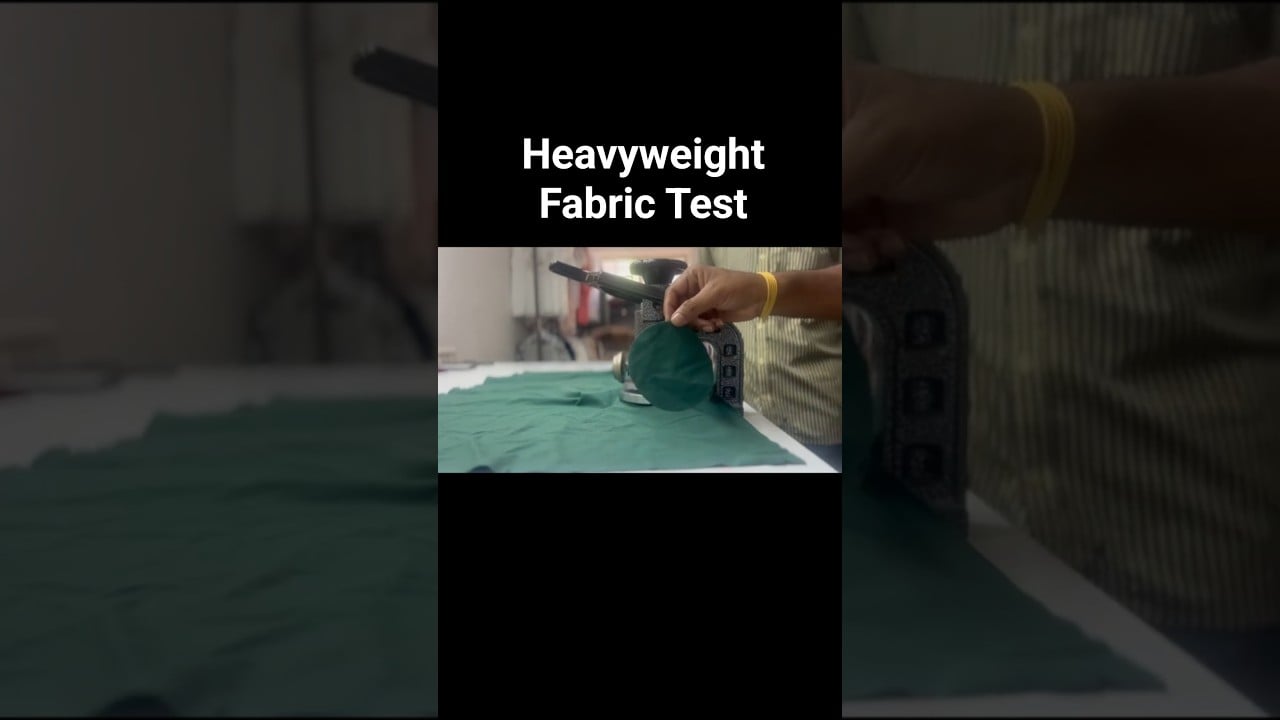
GSM cutter and GSM scale on our quality control bench, Tirupur.
One point of honesty about that clip, because it matters if you are a buyer. Only one swatch is cut in the video, which is enough to demonstrate the method. It is not enough to approve a fabric lot. In real production we cut several swatches across the width of the roll and average them, because fabric weight is not perfectly uniform from selvedge to selvedge, and a single swatch taken from the middle of the roll is exactly how a light lot gets waved through. If a supplier shows you one reading, ask where on the roll it came from.
The Tolerance: Plus or Minus 3%
An approved lab dip carries a GSM figure, and the bulk fabric that arrives afterwards is never a perfect match to it. Knitting is a mechanical process and small variation is normal. The question that matters is how much variation you accept before you stop the lot.
Our working tolerance is plus or minus 3% against the approved weight. Outside that band, the fabric is rejected and re-knitted. On a 300 GSM order that means anything between roughly 291 and 309 GSM is accepted without argument.
The direction of the error also matters, and few suppliers will tell you this plainly. Fabric that comes in heavy costs us more and gives the buyer more than they paid for, which is why the 310 GSM reading in the video was approved rather than rejected. Fabric that comes in light is the one to watch, because the buyer is paying for weight that is not there, and a 5% shortfall on a 180 GSM tee is a garment that visibly hangs differently on the rail. When you agree a GSM with a factory, agree the tolerance in the same sentence, and agree what happens when it is missed on the low side.
Yarn Count and GSM: How to Read a Spec Sheet
Here is the part that lets you catch a supplier who is quoting you something impossible. GSM in a knit fabric is not a free variable. It is a consequence of the yarn count and the loop length, and for single jersey the relationship is reasonably predictable. A finer yarn cannot produce a heavy fabric, and a coarse yarn cannot produce a fine one.
| Yarn count (single jersey) | Typical GSM range | What it produces |
|---|---|---|
| 40s | 120 to 130 GSM | Fine, light, high drape. Summer tops and linings |
| 34s | 130 to 140 GSM | Light knit tops, women’s jersey |
| 30s | 150 to 160 GSM | Standard t-shirt weight for warm climates |
| 25s | 170 to 180 GSM | The standard export t-shirt. Holds shape and takes a print |
Those ranges shift with loop length, which is the other lever on the knitting machine. A longer loop opens the fabric and drops the GSM, a shorter loop tightens it and lifts the GSM, so the same yarn count can be pushed a little either way. The ranges above are what those counts actually deliver in practice on our machines.
Use this to audit a quotation. If a supplier offers you a 220 GSM single jersey knitted from 40s yarn, something is wrong with the specification, and you are entitled to ask what. Either the count is not what they said, or the fabric is not what they said.
What GSM Costs You
Fabric is bought by weight, so GSM and cost are the same conversation. A 220 GSM tee uses meaningfully more cotton per piece than a 160 GSM tee, and the difference lands directly in the garment price with nothing to soften it.
There is a second cost that buyers routinely forget. Greige fabric, the raw knitted fabric straight off the machine before it is dyed and finished, is not what goes into your garment. Taking greige fabric through processing, the dyeing and the finishing, adds roughly 50% on top of the greige fabric cost. So when a trader quotes you a fabric price, the first question is whether that number is greige or finished, because the gap between the two is about half again.
The Honest Upper Limit: Heavier Is Not Better
Most GSM guides read like an argument for buying the heaviest fabric available. That is not how it works on a factory floor, and here is the limit in plain terms.
For single jersey, 240 GSM is the practical maximum. Beyond that you are no longer making a jersey garment, you are making a sweatshirt, and it should be knitted as fleece or French terry instead. A jersey pushed past its sensible weight does not become a premium t-shirt, it becomes a stiff one that hangs badly, holds heat and loses the drape that made a t-shirt worth wearing.
The same logic runs in the other direction. A t-shirt below 150 GSM feels thin on the rail and will disappoint a buyer who has paid a premium price for it. The skill is not in going heavy, it is in matching the weight to the garment, the market and the climate it will be worn in.
GSM by Garment Type
A practical reference for what GSM to specify in fabric and textile terms, based on what we actually knit.
| Fabric weight | GSM range | Typical garments |
|---|---|---|
| Lightweight | 120 to 150 GSM | Summer tops, linings, babywear, intimate apparel |
| Medium | 150 to 200 GSM | T-shirts, women’s jersey, pyjamas |
| Heavy jersey | 200 to 240 GSM | Heavyweight and oversized tees, polos, streetwear |
| Fleece and French terry | 280 to 400 GSM | Sweatshirts, hoodies, winter knitwear |
Producing at the weight you actually specified
Every fabric lot we knit is GSM tested on our own bench before it goes to cutting. See how we build heavyweight streetwear, read the GSM weights t-shirt buyers actually order, or check what GSM a hoodie needs.
Frequently Asked Questions
What is the GSM full form in the garment industry?
GSM stands for Grams per Square Metre, written g/m². It is the weight of one square metre of fabric in grams, and it is the standard measure of fabric weight and density used across the garment, fabric and textile industry.
What is GSM in fabric and how is it calculated?
GSM in fabric is the weight of one square metre of that fabric. It is calculated by cutting a swatch of known area, weighing it, and scaling the weight to a full square metre. A standard GSM cutter cuts 100 square centimetres, which is one hundredth of a square metre, so the swatch weight in grams multiplied by 100 gives the GSM.
What is 180 GSM in clothing?
180 GSM is the standard export t-shirt weight, typically knitted from 25s yarn in single jersey. It has enough body to hold its shape and carry a print, and it is the weight most American and European brands default to.
What is 240 GSM in clothing?
240 GSM is the practical maximum for single jersey and the weight used for heavyweight and oversized tees. Above 240 GSM a jersey stops behaving like a t-shirt and the fabric should be knitted as fleece or French terry instead.
What is 400 GSM in clothing?
400 GSM sits at the top of the fleece and French terry range, used for heavy winter sweatshirts, hoodies and structured outerwear. It is not a t-shirt weight and no jersey should be pushed anywhere near it.
What GSM tolerance should a buyer accept?
Plus or minus 3% against the approved lab dip weight is a reasonable working tolerance, and outside that band the fabric should be rejected and re-knitted. Pay particular attention to fabric coming in light, because a shortfall means you are paying for weight that is not in the garment.
Does higher GSM mean better quality?
No. GSM measures weight and density, not quality. A heavier fabric is not automatically a better one, and a garment pushed past its correct weight becomes stiff, hot and badly hanging. The right GSM is the one that suits the garment, the climate and the market.

About the Author: Karthik Shan
Karthik Shan is the founder and CEO of The Synerg, with 20+ years in the Tirupur textile hub. He publishes practical playbooks for brands on global sourcing, cotton knitwear, fabric GSM, and export-ready production.