

Choosing a clothing factory in India starts with knowing what a garment factory actually does and which kind of factory suits your product. This guide explains how a garment factory works, ranks the top clothing factories in India, shows which type of factory is best for organic, printed, or high-volume orders, and sets out what it costs to set up a garment factory, based on more than 20 years of running production in Tirupur, including our own in-house cutting and sewing unit.
What Does a Clothing Factory Do?
A clothing factory, also called a garment factory or apparel factory in India, is where fabric is turned into finished garments. The work follows the same sequence in every serious export unit: the tech pack is turned into patterns, fabric is checked, pieces are cut, sewn on an assembly line, finished, inspected, and packed for shipping. In Tirupur, the factory is also part of a wider cluster, where yarn, knitting, dyeing, printing, and washing are handled by specialist units close by, and the garment factory coordinates them all.
A garment factory can work in two ways. Under CMT (cut, make, trim), the factory cuts, sews, and finishes, while fabric and trims are supplied or arranged separately. Under full package production, the factory or its sourcing team handles everything from fabric to shipment. We run CMT in-house in our own factory, and manage the full package around it through specialist knitting, dyeing, and printing partners.
The 9 Steps Inside a Garment Factory
Here is what happens inside a clothing factory, with links to our detailed guide for each stage.
- Design and technical planning. The tech pack and size set become the blueprint for production, as our guide to size sets and measurement specs explains.
- Fabric sourcing and knitting. Yarn is knitted into fabric by specialist units, covered in our guide to knitting in clothing and jersey fabric.
- Dyeing. Fabric or garments are coloured, as set out in our guide to dyeing techniques.
- Pattern making and grading. Patterns are made and graded across the size range.
- Cutting. Fabric is spread in layers and cut to the markers.
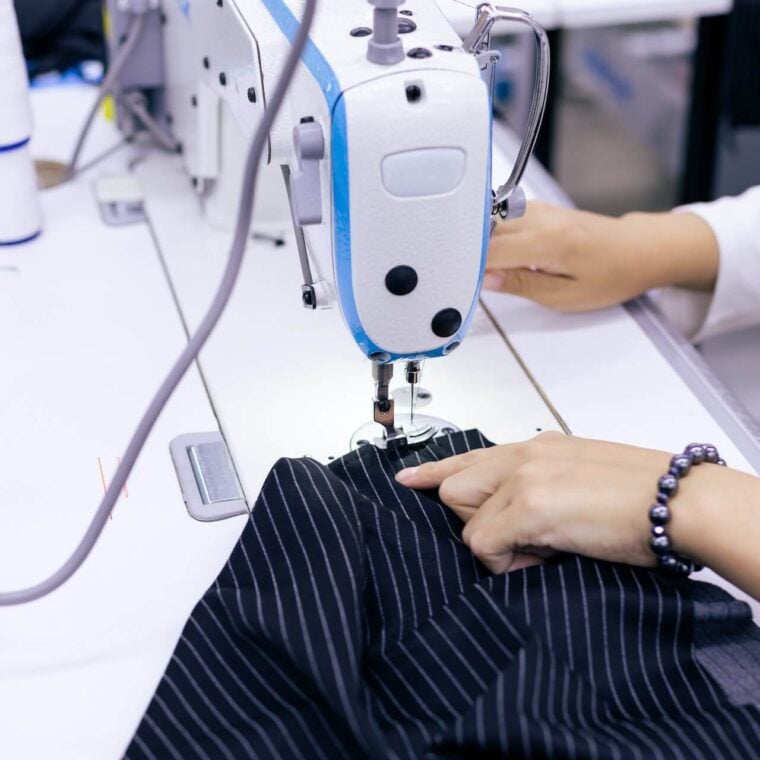
- Sewing and assembly. Operators assemble garments on an assembly line, each handling one operation, which keeps speed and consistency high.
- Printing, washing, and finishing. Decoration, washes, trimming, and pressing, covered in our guides to printing and washing techniques.
- Quality control. Garments are checked against the approved sample and inspected to AQL 2.5.
- Packing and shipping. Garments are packed to the buyer’s packing list and shipped FOB, CIF, or DDP.
The way these steps are run makes a large difference. A manual unit where one tailor makes a whole garment is slower and less consistent than an assembly line, and hand cutting wastes more fabric than automated cutting. For the costing side of these stages, see our guide to t-shirt manufacturing cost in India.
How T-Shirts Are Made in a Factory
T-shirts are the clearest example of how a garment factory works, and they make up much of what we produce. In a t-shirt making factory in India, the knitted jersey arrives dyed and compacted, and it is relaxed before cutting so it does not shrink after sewing. It is then cut in layers, and the pieces move down the line: shoulders are joined on an overlock machine, the neck rib is attached, sleeves are set in, side seams are closed, and the hems are finished on a coverstitch or flatlock machine. Labels go in, loose threads are trimmed, and every piece is checked, pressed, and packed. That is how t-shirts are made in a factory whether the order is 300 pieces or 30,000; what changes is the number of lines running. In our own t-shirt manufacturing factory, those operations run across 100 sewing machines, and heavier fabrics move to 5-thread stitching, a lesson covered in our guide to oversized clothing manufacturers. The neck rib is one of the most common places a t-shirt goes wrong, which our guide to t-shirt collars explains. If you are looking for a t shirt factory in India, ask to see this line running, because the flow of the floor tells you more than any brochure.
Factory, Production House, or Supplier?
Not every business that sells clothing to brands runs a factory, and it helps to know which kind you are dealing with. Apparel manufacturing companies and garment manufacturing companies own their sewing floors and make the garments themselves. A clothing production house or fashion production house manages development and production for brands, sometimes with its own floor and sometimes through partner apparel factories. Clothing sewing manufacturers, often called CMT units, sew only, with fabric supplied by the buyer or a sourcing team. Garment suppliers and apparel suppliers may trade stock or broker orders between brands and factories. Apparel production companies and clothing production companies can be any of these, so the simplest question to ask is: who owns the sewing floor, and where is quality checked? We own ours, with cutting, sewing, and checking done in-house.
Top 10 Clothing Factories in India
The list opens with our own factory, then covers well-known manufacturing clothing companies in India, from the biggest clothing factory groups in India to large specialist exporters. The best clothing manufacturing companies in India for you are the ones whose specialisation matches your product.
1. The Synerg – Tirupur
The Synerg runs its own garment factory in Tirupur with 100 sewing machines, where cutting, sewing, and trimming (CMT) are done in-house and every order is quality checked on our own floor to AQL 2.5. Knitting, dyeing, printing, and washing are handled by specialist partner units across the cluster, including GOTS, OEKO-TEX, and Sedex compliant factories, which is the standard way Tirupur works. We produce t-shirts, hoodies, sweatshirts, kidswear, sleepwear, and knit bottoms for brands from a minimum of 300 pieces per colour per style. For certified production, see our GOTS certified clothing manufacturers in India page.
2. Shahi Exports – Faridabad and Bengaluru
One of India’s largest garment exporters, with many factories producing woven and knit garments for major global retailers at very high volume.
3. Arvind Limited – Ahmedabad
A vertically integrated textile and garment group spanning fabric to finished apparel, strong in denim, wovens, and knits at industrial scale.
4. Gokaldas Exports – Bengaluru
A large exporter producing fashion and technical garments for global brands across woven and knit categories.
5. Pearl Global Industries – Gurugram
A multinational garment manufacturer with factories in India and other Asian countries, supplying large retail programmes.
6. KPR Mills – Tirupur region
A yarn-to-garment group with integrated spinning, knitting, processing, and garmenting, strong in cotton knitwear at high volume.
7. Eastman Exports – Tirupur
A vertically integrated Tirupur knitwear house with strength in fabric development, washing, and garment dyeing.
8. Page Industries – Bengaluru
A large Indian knit manufacturer with deep expertise in comfort wear and consistent finishing at scale.
9. SP Apparels – Tamil Nadu
A knitwear exporter supplying global retailers, with strong compliance and established kidswear capacity.
10. Texport Industries – Bengaluru
An established garment exporter producing across categories for international brands and private label clients.
Which Garment Factory Is Best for Your Order?
Buyers often ask which factories are best for organic cotton, custom printing, or a wide fabric range. The best clothing factory in India for your order is usually a type of factory rather than one name, and the right clothing factory in India depends on what you make.
| If You Need | Best Type of Factory | What to Check |
|---|---|---|
| Cotton knitwear at sensible minimums | Tirupur CMT or full-package knit factory | MOQ, own sewing floor, QC on site |
| Organic or GOTS certified | Factory with GOTS certified partner chain | Transaction certificates for each order |
| Custom printing and embroidery | Factory with dedicated print and embroidery partners | Printed sample after a wash test |
| Wide range of fabrics | Cluster factory with many knitting and dyeing partners | Fabric swatches, lab dips |
| Ethical, audited production | Sedex or equivalent audited factory | Audit report, working conditions |
| Very large retail volume | Large integrated exporter | Capacity, lead time, high MOQs |
For a closer look at conditions on the factory floor, see our guide to working conditions in Tirupur’s clothing factories.
How Much Does It Cost to Set Up a Garment Factory in India?
For anyone planning their own unit, garment manufacturing plant cost depends mainly on size and location. A lean, export-quality 20-machine unit in a rented facility needs an initial investment of about ₹20,00,000 (20 lakh):
| Investment Category | Approximate Cost (INR) |
|---|---|
| Core machinery (20 single-needle, overlock, flatlock, buttonhole) | ₹8,00,000 |
| Cutting and finishing (cutting machines, vacuum tables, steam boilers) | ₹3,00,000 |
| Factory infrastructure (cutting tables, finishing racks, electricals) | ₹2,50,000 |
| Lease and set-up (deposit, fit-out, lighting) | ₹3,50,000 |
| Initial working capital (legal, licensing, first month’s overhead) | ₹3,00,000 |
| Total initial investment | ₹20,00,000 |
These set-up and running costs are also what shape clothing manufacturers’ prices, which is why a factory in a cluster with lower overheads can quote more competitively. Location matters as much as machinery. A garment factory in Tirupur has immediate access to yarn, knitting, dyeing, and skilled labour, and good connections to Chennai and Tuticorin ports. Government schemes such as the PLI (Production Linked Incentive) scheme can reduce long-term costs for units that meet export targets. From managing production in Tirupur for more than 20 years, the factories we see struggle are rarely short of machines; they are short of compliance. International buyers now put ethical working conditions first, so lighting, ventilation, and safety are worth the extra set-up cost, because a compliant unit is the one buyers keep ordering from.
Our recommendation
If you need a clothing factory in India rather than your own unit, choose one with its own sewing floor and on-site quality control, backed by specialist partners for knitting, dyeing, and printing. That is how we work: 100 sewing machines in-house, AQL 2.5 checks on our own floor, and a minimum of 300 pieces per colour per style. Send us your tech pack for a sampled quote.
Frequently Asked Questions
What does a clothing factory do?
A clothing factory turns fabric into finished garments through pattern making, cutting, sewing, finishing, quality control, and packing. In clusters such as Tirupur, the garment factory also coordinates specialist units for knitting, dyeing, printing, and washing.
What are the top clothing factories in India?
Well-known clothing factories in India include The Synerg in Tirupur, Shahi Exports, Arvind Limited, Gokaldas Exports, Pearl Global Industries, KPR Mills, Eastman Exports, Page Industries, SP Apparels, and Texport Industries. The right choice depends on your product, volume, and certifications.
How much does it cost to set up a garment factory in India?
A lean, export-quality 20-machine garment unit in a rented facility needs about ₹20 lakh, covering machinery, cutting and finishing equipment, infrastructure, lease and fit-out, and initial working capital.
What is the difference between CMT and full package production?
In CMT (cut, make, trim), the factory cuts, sews, and finishes, while fabric and trims are supplied separately. In full package production, the factory or its sourcing team handles everything from fabric to shipment.
Which garment factory is best for organic or GOTS certified clothing?
Choose a factory that works through a GOTS certified supply chain and can issue transaction certificates for each order. The certification must cover every stage, from fibre and fabric processing to the garment factory.

About the Author: Karthik Shan
Karthik Shan is the founder and CEO of The Synerg, with 20+ years in the Tirupur textile hub. He publishes practical playbooks for brands on fabric GSM, costing (CM/CMT), AQL quality standards, and export-ready production.