
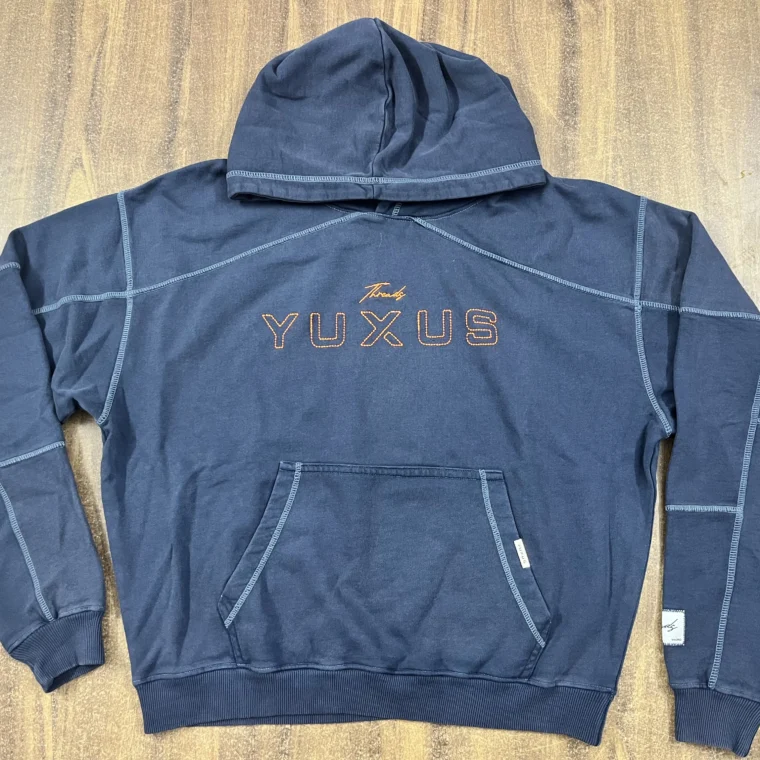

A Manufacturing Analysis of Flatlock vs. Flat Bed Mechanics in Garment-Dye Production
The global shift toward “Heavyweight” streetwear (350GSM+) has exposed critical limitations in standard knitwear machinery. This technical report documents a production bottleneck we encountered with 5-thread flatlock stitching on rigid, 400GSM greige French Terry, and the mechanical protocol required to resolve it.
The Client Challenge: A premium streetwear brand commissioned a line of 400GSM oversized hoodies. The requirement was simple on paper but difficult in execution:
- Fabric: 100% Cotton French Terry (Heavyweight 400GSM).
- State: Greige (Raw/Unfinished) for Garment Dyeing.
- Construction: 5-Thread Flatlock Stitch (for visible, flat seams).
The “Sample Room” Trap
During the sampling phase, the prototypes passed quality control. Skilled operators, working at low speeds on single pieces, successfully executed the flatlock stitch. However, this created a “False Positive.”
The Failure: Once bulk production began, the high-speed Feed-off-the-Arm (FOA) machines failed. The 400GSM greige fabric, lacking softeners, was too rigid (“boardy”). The needles began deflecting, causing skipped stitches and uneven tension that would likely burst during the dyeing process.
★ Karthik’s Production Protocol
The Diagnosis: The standard FOA mechanism could not generate enough grip to feed the rigid 400GSM layers evenly.
The Solution: We halted the line and re-engineered the process using an Industrial Flat Bed Machine. By utilizing a specialized cover-stitch setup with differential feed adjustments, we mimicked the visual appeal of the 5-thread flatlock while providing a stable platform for the heavy fabric.
Technical Results & Data Verification
By switching machinery, we achieved the client’s aesthetic goals without compromising the structural integrity required for the rigorous Garment Dye process.
| Metric | Standard Flatlock (Failed) | Flat Bed Solution (Passed) |
|---|---|---|
| Needle Deflection | High (Frequent Skips) | Zero (Stable Feed) |
| Bursting Strength | Unstable | ISO Standard Compliant |
| Dye Penetration | Uneven (White Lines) | 100% Uniformity |
Recommendation for Sourcing Directors
When specifying 400GSM+ programs intended for Garment Dyeing, do not rely solely on visual samples. Ensure your Tech Pack allows for “Machinery Adaptation.” Rigid greige fabrics require robust feed mechanisms that standard lingerie/activewear flatlock machines cannot support.
Planning a Heavyweight Streetwear Hoodie Collection?
Avoid production delays by consulting with a manufacturer who understands the technical science of GSM and Garment Dyeing.

Karthik Shan
CEO of Synerg and Manufacturing Strategist. With 20+ years of experience in Tirupur’s knitwear cluster, Karthik specializes in solving high-complexity production challenges for global streetwear brands.