
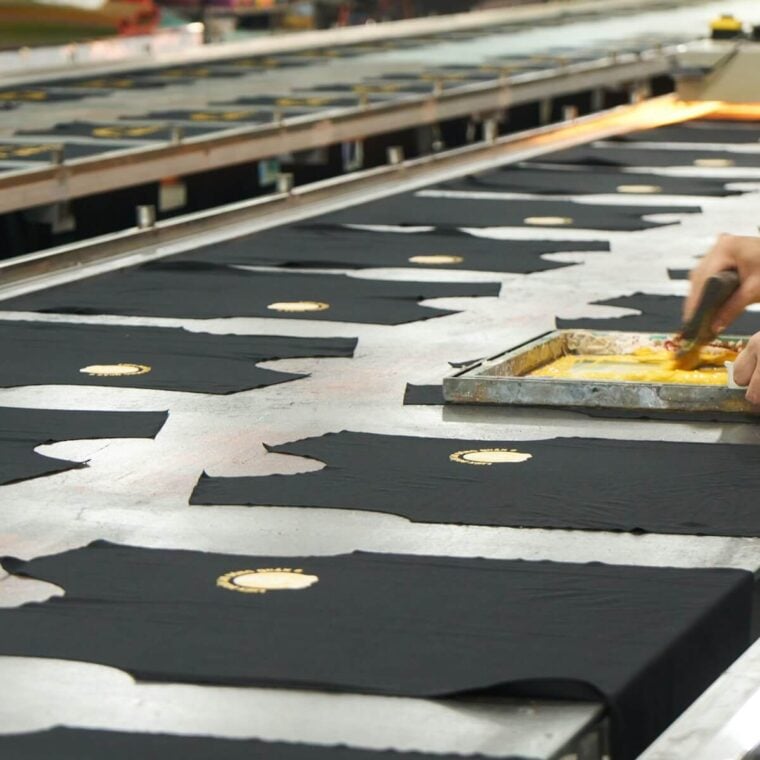

A screen print t shirt manufacturer is still the backbone of printed t-shirt production, but screen printing is only one of several t-shirt printing techniques, and the right one depends on the design, the fabric, and the order quantity. This guide explains each method used in Tirupur, from screen and puff printing to DTG, DTF, sublimation, and full prints, what each looks and feels like, and how printing interacts with dyeing and washing, based on more than 20 years of producing printed t-shirts for export.
Screen Printing
Ink is pushed through a fine mesh screen onto the fabric, one screen per colour. It gives strong, opaque, long-lasting prints, and once the screens are made, each extra piece costs very little, which is why every serious screen print t shirt manufacturer builds its printing around it. The main ink choices are plastisol, which sits on top of the fabric with a bright, slightly raised finish, and water-based ink, which soaks into the cotton for a soft hand you can barely feel. Discharge printing is a variation that removes the dye from dark fabric and replaces it with colour, giving a soft print on dark t-shirts. Screen printing is best for designs with a limited number of solid colours.
Puff Printing
A puff additive in the ink expands under heat to create a raised, three-dimensional print. It is popular for streetwear logos and lettering. A puff print t shirt manufacturer needs to control the ink thickness and curing carefully, because too much puff cracks after washing and too little looks flat.
Glow-in-the-Dark, Reflective, and Metallic Inks
Special effect inks are applied with the same screen process. Glow-in-the-dark ink charges in light and glows afterwards, reflective ink bounces light back for safety and night visibility, and metallic and foil finishes add shine. They cost more than standard inks and usually work best as accents rather than full designs.
Digital Printing: DTG and DTF
Direct-to-garment (DTG) printing works like an inkjet printer on fabric, printing full-colour artwork straight onto the t-shirt with no screens. It suits photographic designs, gradients, and short runs, and it works best on 100% cotton. Direct-to-film (DTF) prints the design onto a film, which is then heat pressed onto the garment. DTF works on cotton, polyester, and blends, handles fine detail well, and has become popular for graphic t shirt manufacturers producing many designs in smaller quantities per design. Both have a higher cost per piece than screen printing at volume.
Heat Transfer and Vinyl
The design is printed or cut onto a transfer sheet or vinyl and applied with a heat press. Vinyl cutting is common for names, numbers, and simple single-colour graphics, such as team and event t-shirts. Transfers are quick to set up but can feel heavier on the fabric than screen or DTG prints.
Sublimation Printing
Sublimation ink turns to gas under heat and bonds with polyester fibres, so the print becomes part of the fabric and does not crack or peel. It gives vivid, all-over colour, but it only works on polyester or high-polyester blends and on white or light fabric. It is the standard method for sports and performance t-shirts, the kind covered in our guide to dri-fit clothing manufacturing.
Full and All-Over Printing
A full print t shirt manufacturer covers the whole garment, seam to seam. On polyester, this is done with sublimation. On cotton, the fabric panels are printed before the t-shirt is cut and sewn, either with large-format screen printing or digital fabric printing, so the design runs across the body without white gaps at the seams. Panel printing needs careful pattern placement so the design lines up across the front, back, and sleeves.
T-Shirt Printing Techniques Compared
| Method | Best Fabric | Best For | Durability |
|---|---|---|---|
| Screen (plastisol / water-based) | Cotton, blends | Solid-colour designs at volume | Very high |
| Puff / special inks | Cotton, blends | Raised logos, effects | High if cured well |
| Discharge | Dark cotton | Soft prints on dark tees | High |
| DTG | 100% cotton | Full-colour, detailed art | Medium |
| DTF | Cotton, polyester, blends | Many designs, fine detail | Medium to high |
| Sublimation | Polyester, light colours | Sports and all-over prints | Very high |
| Heat transfer / vinyl | Most fabrics | Names, numbers, simple graphics | Medium |
Printing, Dyeing, and Washing: Getting the Order Right
Printing sits between dyeing and sewing in most t-shirt production, and it interacts with both. Dark fabric needs either an underbase layer under plastisol or discharge ink to make colours show, so the fabric colour decides the ink system, a point covered in our guide to dyed t-shirt production. Washing matters just as much. If the print goes on before a garment wash, the wash softens and fades it, giving a cracked, vintage look. If it goes on after, the print stays crisp and bright. Neither is wrong, but it has to be decided before production, as our guide to t-shirt washing techniques explains.
How to Specify a Print in Your Tech Pack
Send vector artwork with Pantone colour references. State the print method and ink type you want, or ask the manufacturer to recommend one for your design and fabric. Give the print size and its exact placement, measured from a fixed point such as the neck seam. Say whether the garment will be washed and whether printing comes before or after the wash. And approve a printed sample, ideally after a wash test, before bulk, so you can check the print’s hand-feel, colour, and durability.
Our recommendation
As a screen print t shirt manufacturer, our advice is simple: for cotton t-shirts at production quantities, screen printing gives the best durability and cost. Use puff and special inks for accents, DTG or DTF for detailed multi-colour art, and sublimation for polyester and all-over designs. We produce printed t-shirts from a minimum of 300 pieces per colour per style, including for European brands through our Europe t-shirt manufacturing service. Send us your artwork and tech pack for a sampled quote.
Frequently Asked Questions
What are the main t-shirt printing techniques?
The main techniques are screen printing, puff and special-effect inks, discharge printing, DTG (direct to garment), DTF (direct to film), heat transfer and vinyl, sublimation, and full or all-over printing. Each suits different designs, fabrics, and quantities.
Which printing method lasts longest on t-shirts?
Screen printing and sublimation are the most durable. Screen printing lasts through many washes on cotton, and sublimation becomes part of polyester fibres, so it cannot crack or peel. DTG and transfers are generally less durable.
What is the difference between DTG and DTF printing?
DTG prints ink directly onto the t-shirt and works best on 100% cotton. DTF prints the design onto a film that is then heat pressed onto the garment, and it works on cotton, polyester, and blends. DTF usually handles fine detail and dark fabrics more easily.
Can you sublimate on cotton t-shirts?
No. Sublimation only bonds with polyester fibres, so it needs polyester or high-polyester fabric, ideally white or light in colour. Full prints on cotton are done by printing the fabric panels before the t-shirt is sewn.
Should t-shirts be printed before or after washing?
It depends on the look you want. Printing before a garment wash softens and fades the print for a cracked, vintage finish. Printing after the wash keeps it crisp and bright. The order should be decided before production and shown on the approved sample.

About the Author: Karthik Shan
Karthik Shan is the founder and CEO of The Synerg, with 20+ years in the Tirupur textile hub. He publishes practical playbooks for brands on fabric GSM, costing (CM/CMT), AQL quality standards, and export-ready production.