
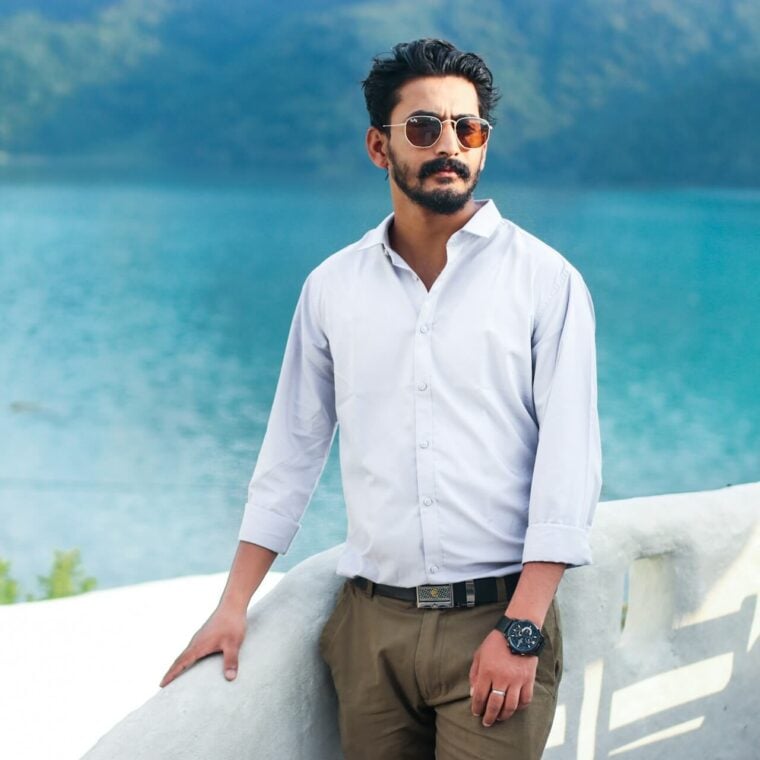

A woven shirt is defined by its structure: it is produced by interlacing two sets of yarns (warp and weft) at right angles. Unlike knitted t-shirts which are loop-based and stretchy, woven shirts are structured, durable, and crisp—making them the standard for formal wear and button-downs.
For any woven shirt manufacturer for Australian brands, the challenge isn’t just sewing; it’s managing the tension and quality of the weave itself. At Synerg, our process for producing high-quality woven garments follows these seven technical stages:
1. Design and Pattern Making
- Design: The process begins with the “Tech Pack.” We select fabrics (Poplin, Twill, Oxford), define the GSM, and finalize style features like collar stiffness and cuff width.
- Pattern Making: Unlike knits, woven fabrics don’t stretch. This means the patterns for the front, back, and sleeves must be cut with precise ease allowances. If the pattern is off by 2mm, the shirt won’t fit.
2. Weaving (The Core Process)
This is where the magic happens. The fabric is constructed on a loom.
- Yarn Preparation: Before weaving, yarns undergo “sizing” (coating with starch) to strengthen them for the high-speed loom.
- Warping: Long yarns (Warp) are arranged parallel on a beam.
- Weft Insertion: A loom (Air-jet or Rapier) shoots the Weft yarn across the Warp at high speeds. This interlacing creates the strong, stable structure of the fabric.
3. Fabric Finishing & Pre-Treatment
Raw fabric from the loom is rough (called “Greige”). It must undergo singeing (burning off loose fibers), desizing, and bleaching. For premium shirts, we also apply finishes like “Liquid Ammonia” or “Mercerization” to give the fabric a silk-like luster and soft hand-feel.
4. Fabric Cutting
- Spreading: The fabric is laid out on long tables. For checked or striped shirts, this step is critical—we have to manually align the layers so the checks match at the side seams (a sign of high quality).
- Cutting: We use automated cutters to slice through 50-100 layers at once, following the marker to minimize waste.
5. Sewing and Assembly
A woven shirt has more components than a t-shirt.
- Collars & Cuffs: These are fused with “Interlining” to make them stiff and crisp.
- Assembly: The front placket is attached, shoulders are joined (yoke), and sleeves are set. We often use “Twin Needle” machines for strong side seams.
6. Finishing & Trimming
Once sewn, the shirt is pressed. For formal shirts, we use “Buck Press” machines that mold the collar and cuffs into perfect shapes. Loose threads are trimmed, and buttons are secured using a lockstitch to prevent unraveling.
7. Quality Control (QC)
Before packaging, every shirt undergoes a final audit. Our Quality Control team checks for puckering at the seams, check alignment, and button security. Defects are flagged and rectified immediately.
Technical Insight: Woven vs. Knit Production
Clients often ask us why woven shirts cost more to produce than t-shirts. It comes down to the complexity of the fabric construction.
| Feature | Woven Shirts (Formal) | Knits (T-Shirts) |
|---|---|---|
| Fabric Construction | Interlaced (Loom) – Rigid & Stable | Interlooped (Knitting Machine) – Stretchy |
| Cutting Precision | High (Must match checks/stripes) | Standard (Focus on grain line) |
| Components | 10+ (Collar, Cuff, Placket, Yoke, etc.) | 4-5 (Front, Back, Sleeves, Neck rib) |
Looking for Premium Shirt Manufacturing?
From Oxford weaves to fine Twills, we handle the entire process. Explore our manufacturing guide to see how we maintain export quality.

Karthik Shan
CEO of Synerg and manufacturing consultant. With 20+ years of experience in the Indian textile hub, Karthik helps global brands leverage India’s production capabilities for export markets.